How SEBI’s Closing Auction Session and Higher STT Are Reshaping India’s F&O Volumes?
India’s derivatives market is facing a structural shift, but the most important development is that regulators are changing both the cost of trading and the mechanics surrounding price discovery.
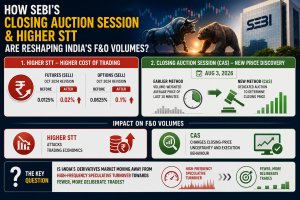
The first lever is taxation. Higher Securities Transaction Tax (STT) has increased the cost of derivatives trading. The October 2024 revision raised STT on future sales from 0.0125% to 0.02% and on options sales from 0.0625% to 0.1% of the premium. The government justified the move against the backdrop of explosive derivatives activity.
The second lever arrived much more recently. On August 3, 2026, SEBI’s Closing Auction Session (CAS) replaced the previous closing-price methodology for F&O-eligible stocks. Instead of relying on the volume-weighted average price of the final 30 minutes, the market now uses a dedicated auction to determine the closing price.
These reforms affect F&O volumes differently:
- Higher STT attacks trading economics.
- CAS changes closing-price uncertainty and execution behaviour.
The key question is therefore not simply whether F&O volumes are falling. It is whether India’s derivatives market is moving away from high-frequency speculative turnover towards fewer, more deliberate trades.
What Actually Happened to F&O Volumes After CAS?
The debate around SEBI’s Closing Auction Session is ultimately a debate about numbers. Did the new mechanism actually reduce derivatives activity, or did traders simply change when and how they traded?
The first month provides a clear warning signal.
In August 2026, equity derivatives turnover on India’s major exchanges fell to multi-month lows. NSE’s equity derivatives turnover dropped to ₹34.48 lakh crore, its lowest monthly level since November 2023, while BSE’s derivatives turnover fell to its lowest level since June 2025.
What the Early Post-CAS Data Shows:
| Indicator | Verified Data | What It Shows |
| NSE equity derivatives turnover (August 2026) | ₹34.48 lakh crore | Lowest monthly level since November 2023 |
| BSE equity derivatives turnover (August 2026) | ₹32.2 lakh crore | Lowest monthly level since June 2025 |
| BSE average daily contracts traded in the first week after CAS | 90 million | Down 30.6% week-on-week |
| Industry average daily contracts traded in the same period | — (not publicly available) | Down 20.4% week-on-week |
| BSE premium per contract | ₹2,605 | Up 74.8% week-on-week |
| BSE average daily premium turnover | ₹23,500 crore | Up 21.3% week-on-week |
Source: The Economic Times, based on exchange data and Nuvama Institutional Equities.
What the data shows: The early impact of CAS was not a straightforward collapse in all forms of derivatives activity. While contracts traded fell sharply, higher option premiums increased premium turnover. This means the August disruption is visible in actual trading participation, but turnover alone cannot measure its full impact.
The timing is important. CAS was introduced in August, meaning the decline occurred immediately after a major change in the way closing prices were discovered for F&O-eligible stocks.
But turnover alone does not tell the complete story.
A proper assessment of CAS must examine three separate indicators:
- Total F&O turnover: Shows the value of trading activity.
- Contracts traded: Shows whether actual trading participation declined.
- Options versus futures mix: Shows whether the reform affected speculative options activity more than futures-based hedging and institutional trading.
This distinction matters because a fall in turnover does not automatically mean an identical fall in participation. Changes in contract values, premiums and trading strategies can also affect turnover.
The evidence currently proves one thing clearly: August marked a sharp disruption in derivatives activity immediately after CAS was introduced. What remains to be established through subsequent exchange data is whether this was the beginning of a lasting decline or the first stage of market adaptation.
Higher STT Changed Trading Economics, But It Does Not Explain the August 2026 Shock
Higher Securities Transaction Tax and the Closing Auction Session are often discussed together, but they should not be treated as the same cause of the recent decline in derivatives activity.
The reason is timing.
The higher STT rates came into effect in October 2024. STT on futures sales increased from 0.0125% to 0.02%, while STT on options sales increased from 0.0625% to 0.1% of the premium.
CAS, however, was introduced much later, in August 2026.
That difference is crucial when identifying what caused the sudden August disruption.
Higher STT was primarily an economic change. It increased the cost of executing frequent derivatives trades and put greater pressure on strategies operating with thin margins. Its impact would therefore be expected to emerge gradually through changes in trading profitability and behaviour.
CAS was a market-structure change. It immediately altered the environment surrounding the closing price of F&O-eligible stocks.
This makes the August timing difficult to explain through STT alone. If the tax increase were the primary trigger, the market would have needed to explain why the sharp disruption appeared nearly two years after the revised rates took effect.
The more logical interpretation is:
- Higher STT changed the long-term economics of excessive turnover.
- CAS appears to have triggered the immediate behavioural disruption visible in August 2026.
One made frequent trading more expensive. The other made trading around the market close more uncertain.
That distinction is essential to understanding what is actually reshaping India’s F&O market.
The Closing Auction Session Changed What The “Close” Means For F&O Traders
CAS is more consequential for derivatives than it initially appears.
Before the reform, closing prices were determined using the VWAP of trades during the final 30 minutes of continuous trading. SEBI replaced this with a dedicated closing auction because the closing price is used as an important reference for derivatives settlement, index calculation and other market processes.
Under the new structure, liquidity is concentrated into an auction designed to discover a single closing price.
That changes the behaviour of traders with positions extending into the close.
Why this matters for F&O:
- The cash-market close is directly relevant to derivatives valuation and settlement.
- Traders can no longer treat the final minutes entirely like ordinary continuous trading.
- Liquidity conditions during the auction can produce sharp differences between intraday prices and indicative closing levels.
- Expiry-day positioning becomes particularly sensitive because settlement-related price movements matter more.
This became visible soon after implementation. Reuters reported sharp swings during the initial weeks, including significant movements in benchmark indicative prices on derivatives expiry days.
Key takeaway: CAS has not changed the derivatives contract itself. It has changed the environment around one of the most important prices used by the derivatives market, the closing price of the underlying securities.
That makes the final part of the trading day strategically more important and, initially, less predictable.
CAS Changed Trader Behaviour And That Is the Strongest Explanation for the August Decline
The immediate impact of CAS appears to have come through a change in trader behaviour rather than a sudden reduction in investor interest in derivatives.
The new closing mechanism changed how the final price of F&O-eligible stocks was discovered. For traders carrying positions into the closing period, this introduced a new source of uncertainty: the final auction could produce significant price movements that were not visible during ordinary continuous trading.
The result was greater caution around the close.
Instead of treating the final minutes of trading as a continuation of the normal market session, traders now had to account for the possibility that auction-related order imbalances could influence the final price of the underlying security.
The traders most affected are likely to be those dependent on:
- Intraday position management.
- Expiry-day strategies.
- Predictable closing prices.
- Tight arbitrage spreads.
- Frequent short-term trading.
This is what makes CAS fundamentally different from higher STT.
STT increases the cost of executing a trade. CAS changes the uncertainty surrounding how positions are valued and managed at the close.
That distinction helps explain why the immediate disruption following CAS appears to be behavioural. The issue is not necessarily that traders no longer want derivatives exposure. Instead, certain short-term strategies may have become more difficult to execute under a closing mechanism that initially introduced greater uncertainty.
This is why CAS appears to be the stronger explanation for the immediate August disruption, while higher STT remains a longer-term factor affecting the economics of frequent trading.
Is CAS Causing a Temporary Disruption or a Permanent Reduction in Activity?
The honest answer is that the market does not yet have enough data to make that conclusion.
August was the first month of CAS. A single month can demonstrate disruption, but it cannot prove whether traders are permanently leaving the derivatives market.
What the available evidence does show is that the market is capable of adapting in some areas.
On August 31, 2026, the closing auction faced its first major institutional test during the MSCI index rebalancing. Approximately $4.1 billion of trades took place during the 20-minute auction window, nearly 40 times the average auction turnover since CAS was introduced.
That does not prove that F&O volumes have recovered.
But it proves something equally important: CAS can handle substantial liquidity when institutional investors have a strong reason to transact at the closing price.
This suggests that adaptation may be occurring unevenly.
Institutional investors and passive funds can benefit from a concentrated closing liquidity pool. Short-term derivatives traders, meanwhile, may need more time to adjust their strategies to auction-related uncertainty.
Therefore, the evidence currently supports a more precise conclusion:
CAS has clearly disrupted F&O trading behaviour, but there is not yet sufficient post-CAS data to prove that the resulting volume decline is temporary or permanent.
The next few months of exchange data will determine which interpretation is correct.
CAS Is Not Destroying Liquidity, It Is Redistributing It
One of the most interesting outcomes of CAS is that derivatives activity and cash-market closing liquidity are moving in different directions.
August saw a decline in F&O turnover, but the new auction mechanism simultaneously demonstrated its ability to concentrate enormous institutional liquidity at the close.
The clearest example came during the August 31 MSCI index rebalancing, when approximately $4.1 billion was traded during the 20-minute closing auction window. That was nearly 40 times the average turnover recorded in the auction since CAS was introduced.
This reveals the real structural change.
CAS does not necessarily reduce liquidity. Instead, it changes:
- Where liquidity appears.
- When it appears.
- Which participants are most comfortable providing it.
For passive funds and institutional investors, concentrated closing liquidity can improve execution because large orders seeking the official closing price enter the same pool.
For short-term F&O traders, the same mechanism can initially increase risk because large order imbalances may influence the final underlying price.
The result is a redistribution of market activity.
The pre-CAS market rewarded continuous trading. CAS creates greater importance for concentrated liquidity at a specific point in the day.
That means the long-term success of the reform should not be judged only by headline F&O turnover. It should also be judged by whether institutional liquidity becomes deeper enough to offset the reduction in short-term speculative activity.
Higher STT And CAS Are Hitting Different Parts Of The F&O Ecosystem
The most analytical way to understand these reforms is to avoid treating “F&O traders” as one homogeneous group.
Different participants are being affected differently.
Higher STT primarily pressures:
- High-frequency traders with thin margins.
- Frequent futures traders.
- Small speculative strategies dependent on repeated turnover.
- Traders whose expected profits are already small relative to transaction costs.
CAS primarily pressures:
- Expiry-day strategies.
- Intraday traders sensitive to closing volatility.
- Arbitrageurs dependent on predictable cash-market closing prices.
- Participants uncomfortable carrying exposure through the auction.
Meanwhile, some participants may actually benefit.
SEBI introduced CAS partly because a concentrated auction can improve execution for large orders and reduce tracking errors for passive funds. SEBI chairman Tuhin Kanta Pandey said mutual fund participation rose from around 5%-6% initially to approximately 20%-25% as the system developed.
This creates a potential long-term transformation:
Retail speculative turnover may face greater friction, while institutional closing liquidity becomes deeper.
That would mean headline F&O volume becomes a less useful measure of market health than before.
The more important question becomes: Who is generating the turnover?
Who Wins and Loses if Lower F&O Volumes Persist?
The financial consequences of lower derivatives activity will not be distributed equally.
Exchanges: NSE and BSE face the clearest volume risk
Exchanges earn transaction-related revenue from trading activity. If lower F&O turnover becomes structural, fewer transactions could directly affect one of the most important revenue engines of India’s exchange industry.
For NSE, the question is particularly significant because of the scale of its derivatives ecosystem.
However, CAS could create an offset. The August 31 MSCI rebalancing showed that the auction mechanism can attract substantial institutional liquidity at the close.
The long-term issue for exchanges is therefore not simply whether volumes fall.
It is whether lost speculative derivatives activity is replaced by deeper institutional trading activity elsewhere in the market.
Discount brokers: fewer trades could hurt transaction intensity
Retail-focused brokers face a different problem.
Their customers may continue investing, but if they trade derivatives less frequently, the number of transactions generated by each active customer can decline.
Higher STT discourages excessive turnover economically, while CAS increases uncertainty around the close. Together, they could reduce the activity of traders who generate the highest transaction frequency.
Market makers: liquidity quality matters more than raw volume
Market makers need predictable opportunities to hedge and manage inventory.
CAS can eventually create deeper closing liquidity, but uneven participation and sharp order imbalances can increase risk during the adjustment period.
The biggest beneficiaries could ultimately be long-term institutional participants. The biggest losers could be business models dependent on extremely high-frequency speculative turnover.
The Main Risk Is Not Lower Volume - It Is a Liquidity Mismatch Between Cash And Derivatives
The real structural risk created by these changes is a potential mismatch.
India’s derivatives market depends on efficient interaction between:
- the underlying cash market,
- futures,
- options,
- arbitrage activity,
- market makers.
If cash-market closing prices become concentrated in an auction while derivatives liquidity remains dependent on continuous trading behaviour, temporary disconnects can emerge , particularly near expiry.
That risk became visible in the early CAS sessions, when sharp movements in indicative prices raised concerns among market participants. Reuters reported that limited liquidity and market depth were among the factors blamed for the initial volatility.
SEBI and market participants have already been working to improve the transition.
Reuters reported that brokers were asked to begin accepting orders during the earlier transition period to improve participation and price discovery.
This suggests an important point:
The regulator is not treating the first version of CAS as the finished market structure.
The system is being refined based on actual trading behaviour. That matters for interpreting August volumes. A market undergoing a major microstructure change should not be judged solely by its first few weeks.
The real test is whether liquidity returns after participants adapt to the new closing mechanism.
Conclusion
India’s F&O market is clearly being reshaped, but the evidence does not yet justify declaring that the market is either permanently shrinking or fully adapting.
The two reforms have played different roles.
Higher STT changed the economics of frequent derivatives trading by increasing transaction costs. CAS changed market behaviour immediately by introducing a new closing-price mechanism.
The timing of the August 2026 disruption points more directly towards CAS as the immediate trigger. NSE’s equity derivatives turnover fell to ₹34.48 lakh crore, its lowest monthly level since November 2023, while BSE’s derivatives turnover fell to its lowest level since June 2025.
But one month is not enough to establish a permanent trend.
The market should now be judged through three measurable indicators.
- F&O contracts traded
A recovery in the number of contracts would show that actual trading participation is returning rather than merely turnover increasing because of higher contract values.
- Average daily F&O turnover
This will reveal whether August was an abnormal adjustment month or the beginning of a structurally lower level of trading activity.
- Options and futures mix
This may be the most revealing indicator. If speculative options activity remains weak while futures and institutional participation stay resilient, CAS may be changing the composition of India’s derivatives market rather than simply shrinking it.
These numbers will provide the real answer.
If trading participation recovers while closing-auction liquidity continues to deepen, CAS will have caused a temporary disruption but a permanent change in market behaviour.
If contracts traded and average turnover remain structurally lower after traders have had time to adapt, India will have entered a genuinely smaller F&O market.
For now, the most defensible conclusion is not that India’s F&O market is in retreat.
It is that August 2026 created the first measurable test and the next few months of volume data will determine whether the market is adapting or permanently contracting.