ACE Stock FY27 Outlook: Seasonal Revenue Cycles and Growth Targets
Action Construction Equipment (ACE) enters FY27 with a much bigger question than simply whether revenue can recover.
The company generated roughly ₹3,395 crore of revenue in FY26, while management is targeting ₹6,000-6,200 crore by FY29-30. That means ACE has to add roughly ₹2,600-2,800 crore of annual revenue and build a business nearly 1.8 times its current size.
So the central question is that can ACE realistically build the additional ₹2,600-2,800 crore required to reach ₹6,000-6,200 crore - and which businesses will actually contribute that growth?
The answer cannot come from the traditional crane business alone. ACE is simultaneously increasing its construction-equipment presence, scaling defence, expanding exports and entering heavier crane categories through KATO.
FY27 therefore matters because it should provide the first evidence of whether these businesses are becoming meaningful revenue contributors or are still largely strategic initiatives.
Q1 FY27 provides a positive starting point, with standalone total income of approximately ₹836 crore, up around 19% YoY, while the core cranes, construction equipment and material-handling segment grew about 22% to ₹738 crore.
But one quarter does not prove the medium-term target.
The real test is whether ACE can sustain volume growth, expand its addressable market and add enough manufacturing capacity to support the ₹6,000-6,200 crore objective without sacrificing margins.

ACE's Growth Will Have to Come From More Than Cranes
The ₹6,000-6,200 crore target cannot be achieved simply by selling more of ACE's existing pick-and-carry cranes.
The company is expanding across tower cranes, construction equipment, material handling, defence, exports and heavier cranes through the KATO partnership.
That diversification matters because it creates several separate revenue pools.
The key question is no longer whether these businesses have potential. It is how quickly each one can move from a small contributor to a meaningful part of revenue.
That becomes the framework for analysing ACE's FY27-FY30 growth.
Q1 FY27: The Recovery Has Started
ACE's Q1 FY27 performance provides an encouraging starting point.
Standalone total income reached approximately ₹836 crore, representing around 19% YoY growth.
EBITDA stood at approximately ₹170.6 crore, while PAT was around ₹118.6 crore. EBITDA margin remained strong at approximately 20.4%.
More importantly, the core cranes, construction equipment and material-handling business grew faster than overall revenue, with segment revenue increasing around 22% YoY to approximately ₹738 crore.
This tells us something more useful than simply saying that revenue grew 19%. The core business appears to be recovering and that recovery was accompanied by strong profitability.
However, Q1 should not be interpreted as proof that ACE will automatically deliver 19 - 20% growth for the full year.
The company itself remains cautious about giving a precise full-year FY27 revenue target because of factors such as commodity inflation, geopolitical uncertainty and uneven external conditions.
For a seasonal capital-goods company, the first quarter gives only part of the picture.
Volume Growth Is the More Important FY27 Signal
For ACE, the quality of growth matters as much as the headline revenue number.
Q1 FY27 provides the first useful evidence: the core business grew roughly 22% in revenue, while volumes also increased.
That distinction matters because the ₹6,000 - 6,200 crore target requires sustained increases in the number and value of machines sold, rather than growth coming mainly from price increases.
Investors should therefore track three things together:
- Core equipment volumes
- Revenue per machine/product mix
- Capacity utilisation
If volumes continue rising while ACE shifts towards larger and higher-value equipment, the company can grow revenue without relying entirely on price increases.
The Margin Story: Can ACE Protect Profitability?
ACE's margin performance is another area where the numbers need context. Q1 FY27 EBITDA margin was around 20.4%, showing that the company was able to maintain strong profitability despite cost pressures.
But management's commentary makes the situation more nuanced.
Commodity inflation, particularly steel, has been a significant challenge. ACE has responded through calibrated price increases rather than simply accepting the entire cost increase.
This is important because it demonstrates that ACE has some pricing power. However, investors should not assume that a 20% quarterly EBITDA margin will automatically become the FY27 average.
Management's operating-margin expectations are more conservative. The real test is therefore not whether ACE can produce one quarter of high margins. It is whether it can protect margins while volumes expand.
That is a much more difficult task.
If commodity prices stabilise and volumes rise, margins could benefit from operating leverage.
But if input costs continue rising faster than price increases, some of that benefit could disappear.
Therefore, FY27 profitability will depend on three moving parts: Commodity costs, pricing and capacity utilisation.
Before looking at ACE's individual growth drivers, it is worth stepping back and looking at the broader infrastructure opportunity. India's rapid expansion in data centres is creating a new wave of demand for power, cooling and specialised infrastructure. Here you can watch my video on Data center stocks
Growth Driver 1: Core Cranes and Construction Equipment
The core business will have to do most of the heavy lifting in reaching ₹6,000-6,200 crore.
ACE generated around ₹3,395 crore of revenue in FY26, so the company needs another ₹2,600-2,800 crore by FY29-30.
The core cranes, construction equipment and material-handling segment already grew around 22% YoY in Q1 FY27 to approximately ₹738 crore.
This makes the existing business the most credible near-term source of incremental revenue.
The growth equation is straightforward:
Higher volumes, larger equipment, stronger tower-crane demand, construction-equipment expansion is equal to the foundation of the ₹6,000-6,200 crore target.
The important test is scale.
ACE's existing manufacturing setup can support revenue of more than ₹5,000 crore, with scope to reach around ₹6,000 crore through incremental investments.
That means the existing platform is broadly capable of supporting the target, but the company still needs additional investment as volumes move towards the upper end of its revenue ambition.
For investors, this is the least speculative part of the growth story: ACE does not need to create a completely new business to reach ₹6,000 crore. It needs to substantially scale the business it already operates while adding new revenue pools around it.
Growth Driver 2: Tower Cranes and Construction Equipment
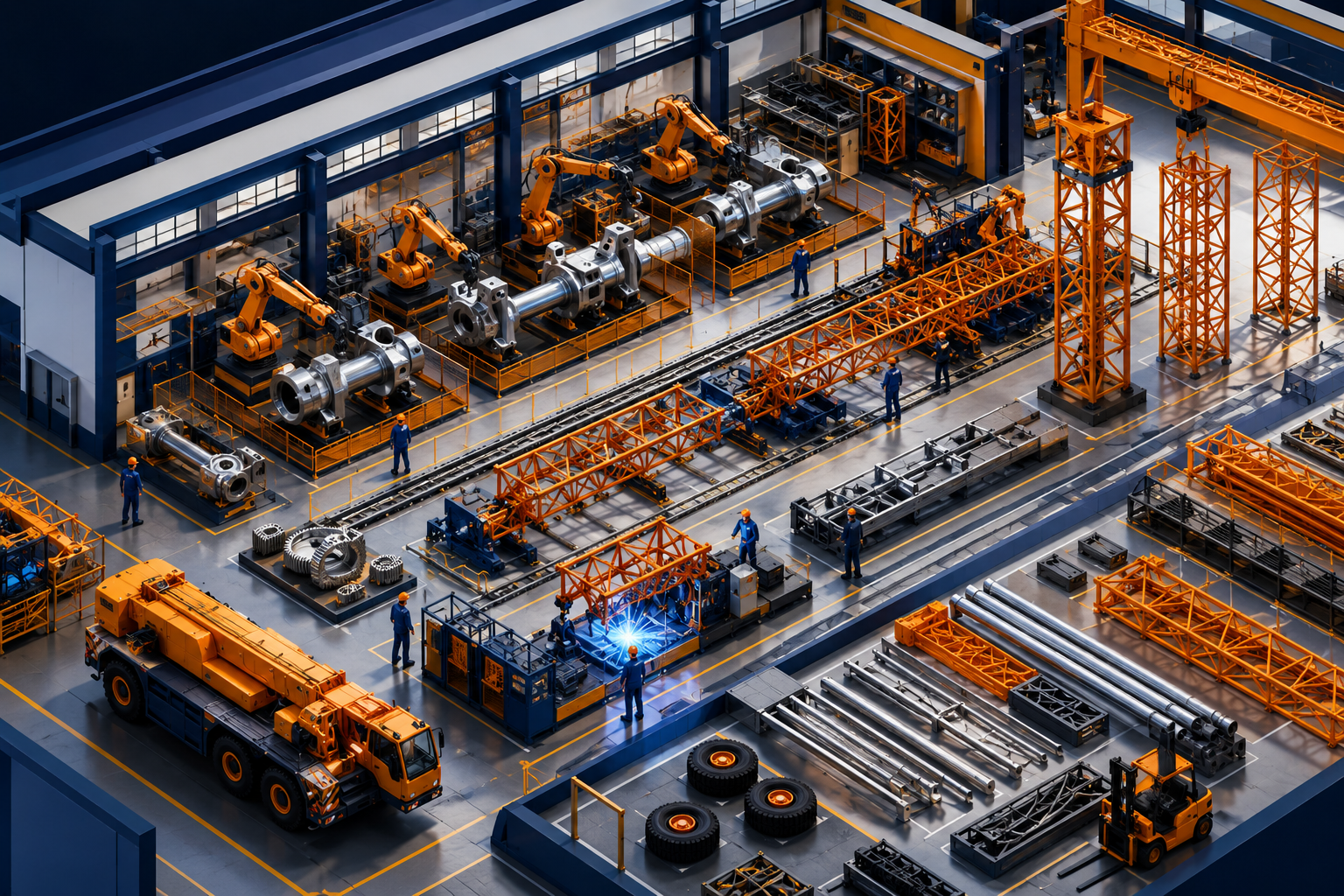
Tower cranes and construction equipment are important because they expand ACE's revenue beyond its traditional crane base.
Tower cranes already have meaningful market traction, while ACE is also scaling backhoe loaders and road-construction equipment. The company's existing integrated manufacturing setup has annual capacity of about 27,000 units, supporting revenue above ₹5,000 crore.
The key test is therefore not whether ACE has entered these categories. It is whether these categories can add enough revenue to reduce the burden on the traditional crane business.
Management expects tower-crane capacity to scale towards roughly 950-1,000 units, which gives this segment a measurable capacity target rather than simply a long-term opportunity.
For FY27-FY30, investors should track tower-crane volumes and construction-equipment revenue separately. If both continue scaling, they can become a meaningful second layer of growth alongside the core crane business.
Growth Driver 3: Defence - From Order Book to Repeatable Revenue
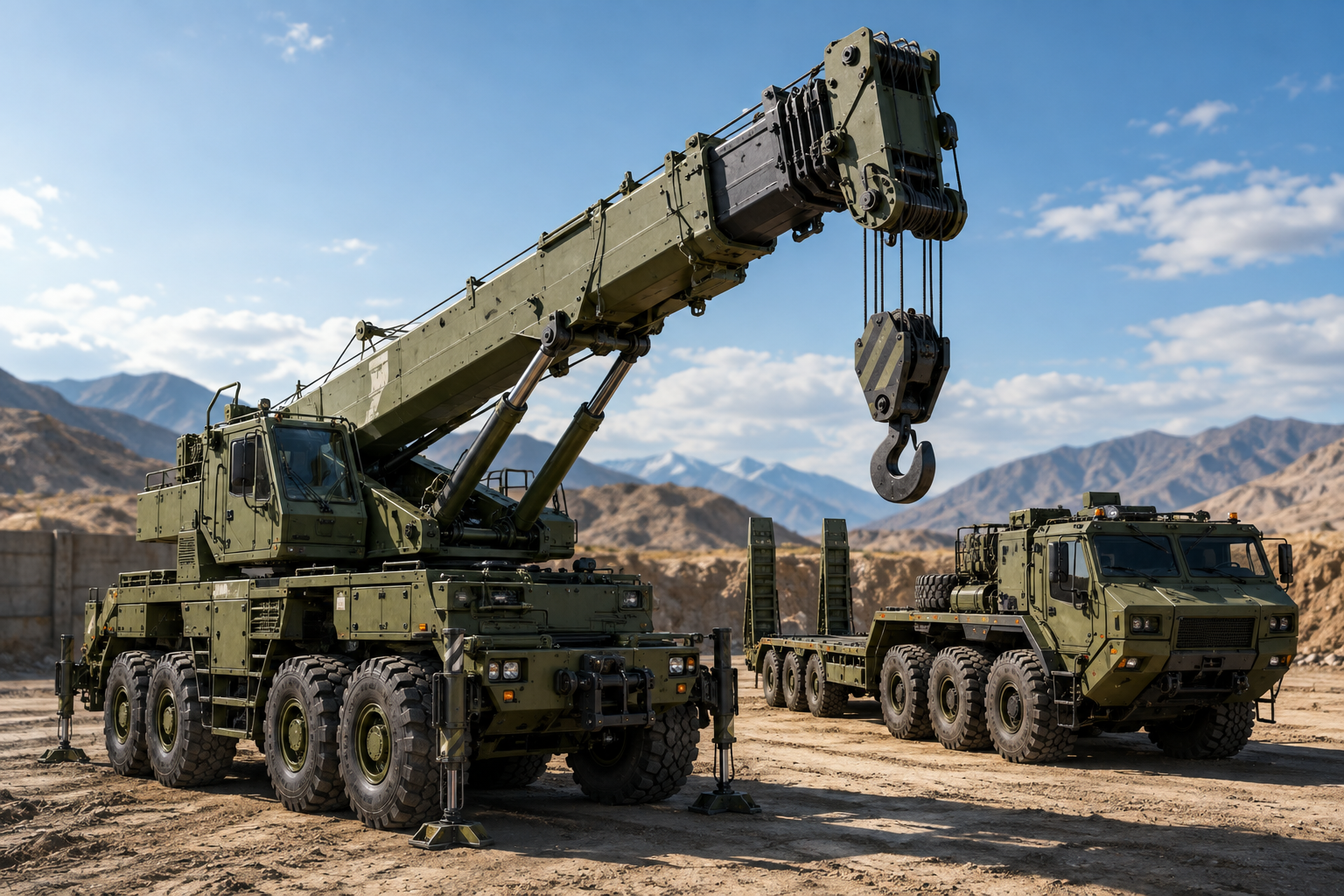
Defence should not be analysed simply as a promising new business. It should be treated as a conversion test.
Current scale: ACE entered FY27 with a defence order book of around ₹575 crore. Management expects defence to contribute approximately 5-6% of FY27 revenue, equivalent to roughly ₹200-220 crore.
Required scale: At the ₹6,000-6,200 crore revenue level, even a 5-6% defence contribution would represent roughly ₹300-370 crore of annual revenue. A larger contribution would be required if defence is expected to become one of ACE's major growth engines.
Evidence: The existing order book provides visibility, while ACE is also investing in a dedicated defence/new-products plant as part of its FY27 capex plan.
The risk: The key uncertainty is not whether ACE can win defence orders. It is whether the company can convert the current order book into recurring annual revenue and build a larger pipeline behind it.
Therefore, the FY27 metric to watch is simple: ₹200-220 crore of defence revenue is the first checkpoint. The longer-term test is whether this can move towards ₹300 crore-plus and remain repeatable.
Growth Driver 4: Exports - From Small Contributor to Meaningful Revenue Pool

Exports are currently too small to justify treating them as a major FY27 growth engine, but they could become important by FY30.
Current scale: Exports account for roughly 4-5% of ACE's revenue and have been growing at around 30% YoY. ACE already has a presence across more than 42 countries.
Required scale: Management has indicated that exports and defence together could reach 15-20% of revenue by FY30. At ₹6,000-6,200 crore of revenue, that represents approximately ₹900-1,240 crore of combined revenue.
That makes exports strategically important because they would need to become several times larger than their current contribution if the company is to reach the upper end of its diversification ambitions.
Evidence: Export growth is already visible, and the KATO partnership gives ACE access to heavier crane technology and potentially wider international markets.
The risk: The business must still establish distribution, certifications, after-sales support and competitive positioning in overseas markets.
The FY27 test is therefore not whether exports exist. It is whether their share can move meaningfully beyond the current 4-5% level and whether growth remains strong enough to support the FY30 target.
Growth Driver 5: KATO - The Biggest New-Product Test
The KATO partnership is strategically important, but investors should not count it as a large FY27 revenue contributor yet.
Current scale: The 50:50 ACE-KATO joint venture is focused on truck cranes, crawler cranes and rough-terrain cranes - categories that are more specialised than ACE's traditional products.
Required scale: The partnership needs to become a meaningful contributor to the ₹6,000-6,200 crore target rather than remaining a technology and product-development initiative.
Management has indicated that KATO-related revenue could reach around ₹300 crore over three to four years in a base case, with a higher outcome possible if market conditions and anti-dumping protection support the segment.
Evidence: The JV gives ACE access to Japanese heavy-crane technology while allowing the company to combine this with its Indian manufacturing base.
The risk: Heavy cranes require customer acceptance, manufacturing scale and execution before they can materially affect consolidated revenue.
Therefore, KATO should be viewed as a FY28-FY30 growth lever, not a reason to inflate FY27 estimates.
Source - ACE Annual Reports and Investor Presentation
The ₹6,000–6,200 Crore Target: Where Does the Growth Actually Come From?

This is the most important question for investors. ACE generated approximately ₹3,395 crore in FY26. To reach ₹6,000-6,200 crore by FY29-30, the company needs to add approximately ₹2,600-2,800 crore of annual revenue.
That requires roughly 15-16% annual revenue growth over four years.
The target therefore needs multiple engines to work together:
| Growth engine | FY27-FY30 role | What needs to happen |
| Core cranes | Primary engine | Sustained volume growth and larger equipment mix |
| Construction equipment | Secondary engine | Backhoe and road-equipment scale-up |
| Tower cranes | Secondary engine | Capacity expansion towards ~950-1,000 units |
| Defence | Diversification engine | Move beyond ₹200-220 crore FY27 revenue |
| Exports | Diversification engine | Increase materially from current 4-5% share |
| KATO/heavy cranes | New growth engine | Scale towards meaningful FY28-FY30 revenue |
The important point is that ACE does not need one new business to generate the entire ₹2,600-2,800 crore gap.
The existing crane and construction-equipment franchise should remain the largest contributor, while defence, exports, tower cranes and KATO need to collectively provide the incremental diversification.
That is also why the target is achievable only if ACE executes across several businesses simultaneously.
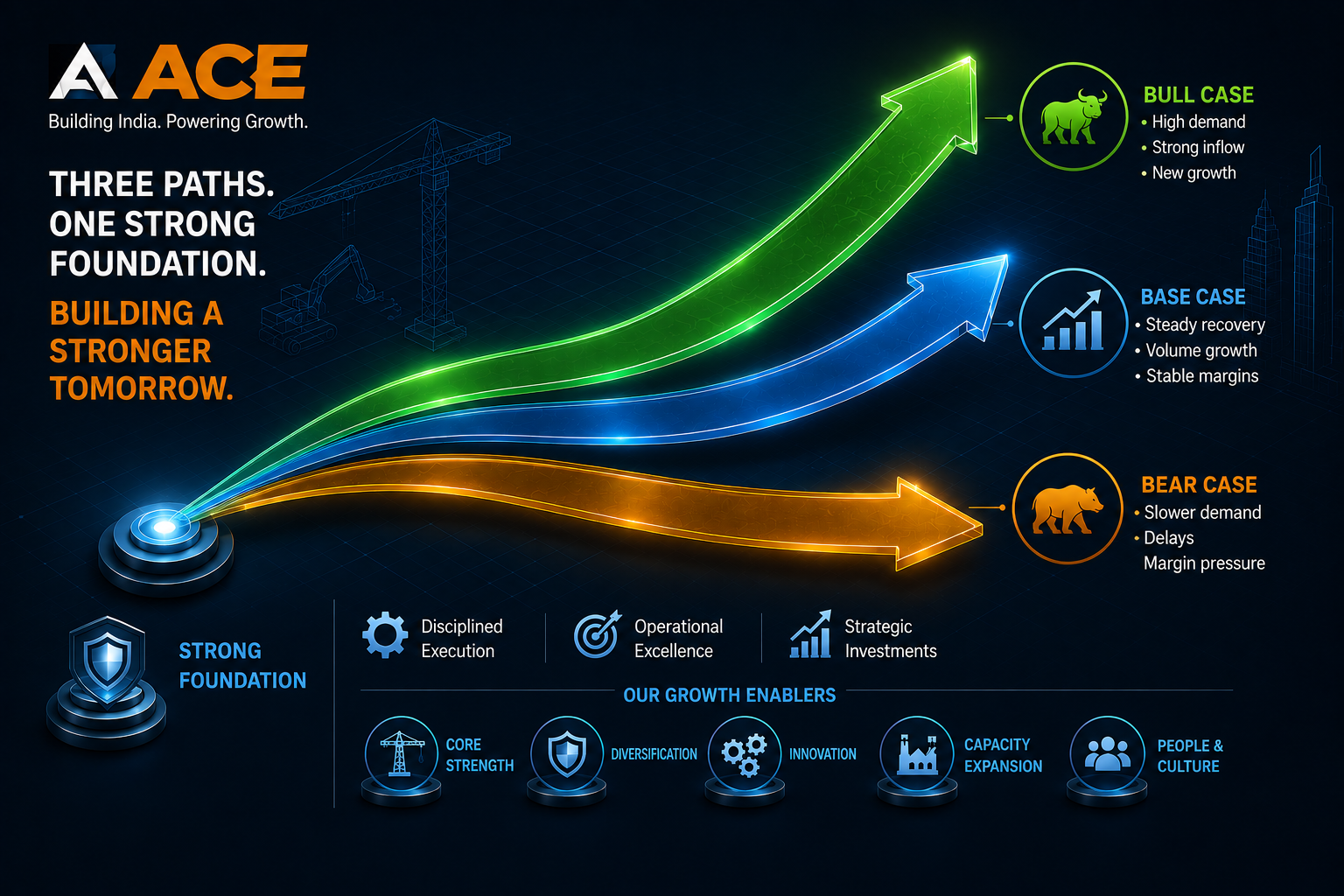
The Bull Case
If core equipment volumes remain in the mid-to-high teens, tower cranes scale towards 1,000 units, defence and exports expand faster than management's current mix expectations, and KATO gains traction.
ACE can approach the upper end of the ₹6,200 crore target by FY29.
The Base Case
A more reasonable base case is that the core business remains the dominant growth driver, while defence and exports gradually increase their contribution and KATO becomes meaningful only towards FY29-30.
Under this scenario, ₹6,000 crore becomes achievable around FY30 rather than being pulled forward.
The Bear Case
The bear case is not that ACE's business stops growing. It is that the core crane cycle remains weak, new businesses take longer to scale and capacity investments are made ahead of demand.
In that scenario, ACE could remain below the ₹6,000 crore threshold even if the underlying business continues expanding.
This framework is more useful than simply asking whether ACE will hit its target because it shows what has to go right - and what can go wrong.
Key Risks Investors Should Watch
The ₹6,000 - 6,200 Crore Target Gets Delayed
The biggest risk is not necessarily a collapse in demand. It is slower-than-planned scaling.
The target requires ACE to move from ₹3,395 crore of FY26 revenue to ₹6,000-6,200 crore by FY29-30. If the core business grows slower than expected or new businesses take longer to scale, the target could shift towards the later end of the timeframe.
Capacity Is Added Ahead of Demand
ACE is investing in land, defence/new-product capacity and manufacturing expansion. The risk is that capacity additions run ahead of actual orders.
That would increase depreciation and fixed costs without generating the corresponding revenue growth.
Defence and Exports Do Not Scale
The diversification story depends partly on businesses that are still relatively small.
Defence is expected to contribute ₹200-220 crore in FY27, while exports currently represent roughly 4-5% of revenue.
If these businesses fail to scale, the burden of reaching ₹6,000–6,200 crore falls disproportionately on the traditional crane and construction-equipment business.
Input-Cost Pressure
Steel inflation remains a margin risk. ACE has demonstrated an ability to increase prices, but the investment case requires margins to remain healthy while volumes expand.
Execution Across Too Many New Businesses
ACE is simultaneously expanding in defence, exports, construction equipment, tower cranes and heavy cranes.
The opportunity is large, but management is effectively running several growth projects at the same time. The more important question is therefore not whether each initiative is attractive individually, but whether ACE can scale them without losing focus or capital efficiency.
ACE FY27 Outlook: The First Test of the ₹6,000 Crore Plan
ACE's FY27 outlook should be judged against the ₹6,000-6,200 crore medium-term target rather than in isolation.
The first checkpoint is FY27 revenue. Management had previously indicated a ₹4,000-4,400 crore revenue range for FY27, while the longer-term target remains ₹6,000-6,200 crore by FY29-30.
That creates a clear progression:
FY26: -₹3,395 crore – FY27: ₹4,000-4,400 crore – FY29–30: ₹6,000-6,200 crore.
The first step requires the recovery in the core business to continue.
The second requires the company to add roughly ₹1,600-2,200 crore beyond the FY27 level through a combination of core volume growth, construction equipment, tower cranes, defence, exports and KATO.
This is why FY27 is important: it should show whether ACE is merely recovering from FY26 normalisation or actually moving onto the growth path required to reach ₹6,000-6,200 crore.

Final Verdict: The ₹6,000 Crore Target Is Achievable, But It Is Not Yet Proven
ACE's investment case is no longer simply a bet on India's infrastructure spending.
The bigger opportunity is the company's ability to scale an existing crane franchise while building new revenue pools in construction equipment, tower cranes, defence, exports and heavy cranes.
The numbers make the challenge clear.
ACE needs to move from approximately ₹3,395 crore of FY26 revenue to ₹6,000-6,200 crore by FY29-30. That requires roughly 15-16% annual growth and an additional ₹2,600-2,800 crore of annual revenue.
The good news is that the company already has the manufacturing platform, market position and product expansion underway to make that target credible. Q1 FY27's 22% growth in the core business also provides early evidence that the recovery is not purely price led.
But the target should not be treated as guaranteed.
The core crane and construction-equipment business has to remain the primary growth engine.
Defence needs to move beyond ₹200-220 crore of FY27 revenue, exports need to become a much larger contributor, tower-crane capacity needs to scale and KATO needs to translate into actual heavy-crane revenue.
My base-case view
₹6,000 crore by FY30 looks achievable. ₹6,200 crore requires stronger execution across the newer growth engines.
That distinction matters for investors.
At this stage, I would not value ACE purely on the assumption that every growth initiative succeeds. The more appropriate approach is to track whether the company is progressing through the milestones required to reach the target.
The most important ones are:
- FY27 revenue moving towards ₹4,000–4,400 crore
- Sustained core equipment volume growth
- Tower-crane capacity approaching 950-1,000 units
- Defence revenue moving beyond ₹200-220 crore
- Exports moving materially above the current 4-5% revenue contribution
- KATO beginning to contribute meaningful revenue
- Capacity expansion remaining aligned with demand
- Margins remaining healthy as volumes increase
If these indicators move in the right direction, the ₹6,000-6,200 crore target becomes increasingly credible.
If the core business recovers but defence, exports and KATO remain small, ACE can still grow - but the path towards ₹6,200 crore becomes much harder.
That is the real investment judgement on ACE: the ₹6,000 crore target is credible, but the ₹6,200 crore outcome requires multiple growth engines to scale successfully. Investors should therefore track the evidence behind the target, not simply the target itself.